An I-40 truck accident in Oklahoma City can involve a state trooper, a federal database, and several insurance policies. I-40 is one of three major interstates that meet near downtown, and in central Oklahoma it carries more than 10,000 trucks a day.
Graves McLain Injury Lawyers represents people hurt in these crashes, and the answers start with which agencies investigate, what records they create, and which policies may pay.
The Oklahoma Highway Patrol has primary traffic enforcement authority on interstate highways, including I-40 through Oklahoma City, under Okla. Stat. tit. 47, § 2-117. Troopers also carry a duty under Oklahoma’s Highway Patrol authority statute to investigate and report collisions on every interstate, and they may investigate other crashes inside city limits when the local agency asks.
The Highway Patrol’s Troop A is headquartered in Oklahoma City, and the Oklahoma City Police Department provides accident reports through its Records Unit. A crash that starts on an I-40 ramp or spills onto a city street can involve both agencies, so we request records from both.
I-35 and I-44 meet I-40 at either end of the four-mile stretch known as the Crosstown. That stretch was designed to carry about 173,000 vehicles a day on five lanes in each direction, and it falls within the Highway Patrol’s interstate authority.
In an interstate truck accident investigation in Oklahoma, the collision report is the first document we read. Its commercial vehicle block records the truck’s USDOT number, the carrier’s name, the weight rating, the cargo body type, and whether hazardous materials were involved and a placard was required.
Federal agencies play a limited role after an I-40 truck crash in Oklahoma City: the Federal Motor Carrier Safety Administration (FMCSA) reviews trucking companies’ safety records and state-reported crash data, and the National Transportation Safety Board (NTSB) investigates only the highway crashes it selects.
FMCSA regulates trucking companies. Its Safety Measurement System includes a Crash Indicator measure built from state-reported crashes that meet reportable crash standards.
Federal trucking safety rules define an accident as an event involving a commercial motor vehicle on a highway that results in a death, an injury that sends someone for immediate medical treatment away from the scene, or a vehicle towed away with disabling damage.
A carrier can ask FMCSA to review whether a crash of an eligible type was preventable through the Crash Preventability Determination Program. Crashes found not preventable come out of the Crash Indicator calculation but stay publicly listed. FMCSA can rate a carrier satisfactory, conditional, or unsatisfactory after a comprehensive compliance review.
Federal law lets the NTSB investigate a highway accident the board selects, alongside any state investigation, under 49 U.S.C. § 1131. Its highway investigations cover selected crashes that raise broad safety issues.
I-40 freight corridor accidents that draw an NTSB investigation are the exception, so we work from the state report and carrier records.
Service Oklahoma handles requests for the state collision report after an I-40 truck accident in Oklahoma City, and access is limited. Requests go in on the Collision Request for Records form, in person or by mail.
The form states that a person may obtain only their own collision report, subject to listed exceptions. Those exceptions include government agencies, insurers investigating a claim, and legal uses tied to court, administrative, or arbitration proceedings. They also cover an investigation in anticipation of litigation, meaning fact gathering before a possible lawsuit.
The USDOT number on the report links the truck to a motor carrier. We run that number through the SAFER Company Snapshot, which can be searched by MC number or company name. The snapshot shows the carrier’s identification, size, commodity information, any safety rating, roadside out-of-service inspection summary, and crash information.
The records that can follow an I-40 truck crash include:
We pull these records early so we know which companies and policies are involved.
Payment for injuries after an I-40 truck accident in Oklahoma City starts with the motor carrier’s liability insurance, and federal and Oklahoma rules set the minimum coverage that company must carry.
The tractor and trailer can belong to someone other than the carrier running the load. Because more than one policy can apply to a single crash, a claim can involve more than the trucking company’s insurer. OKC trucking company liability begins with identifying which policies exist, and we trace each one early.
Federal minimum insurance requirements apply to for-hire interstate property carriers and hazardous materials carriers, even some that operate only within one state. The required amount depends on the cargo under federal minimum insurance rules for motor carriers, 49 C.F.R. § 387.9:
These amounts are minimums a carrier must have in effect before it operates, not a limit on what a claim is worth.
The MCS-90 endorsement commits the carrier’s insurer to pay, within the endorsement’s limits, any final judgment against the carrier for public liability from negligence in the operation, maintenance, or use of its trucks. It is a federal endorsement, a standard form attached to a motor carrier’s liability policy. No condition or limitation in the policy relieves the insurer of that payment.
Because the endorsement attaches to the policy rather than individual trucks, it applies to every vehicle operated under that policy that is subject to federal financial responsibility rules, whether or not the policy lists it. The carrier agrees to reimburse the insurer for payments tied to a breach of the policy or that the insurer would not otherwise have owed.
For-hire carriers operating only inside Oklahoma must keep proof of liability insurance on file with the Oklahoma Corporation Commission under intrastate motor carrier licensing. The Commission’s rule sets $750,000 for nonhazardous property carriers using vehicles rated 10,000 pounds or more and $300,000 for those using only lighter vehicles. It sets $350,000 for restricted property such as sand, rock, gravel, and unprocessed agricultural commodities, and federal amounts for hazardous materials.
A single semi-truck on I-40 through Oklahoma City can involve a driver, a truck owner, a motor carrier, a freight broker, and a shipper, and federal leasing and broker rules define how several of those roles fit together.
When a carrier leases a truck from an owner-operator, the lease must give the carrier “exclusive possession, control, and use of the equipment” for the lease term under federal truck leasing rules, 49 C.F.R. § 376.12. The lease must state the carrier’s duty to keep insurance that protects the public. The same rule says this language does not decide whether the driver is an employee or an independent contractor.
Federal rules define a broker as someone who, for pay, arranges or offers to arrange the transportation of property by an authorized motor carrier. Under federal broker bond requirements, brokers must keep a $75,000 surety bond or trust fund, which covers payments to shippers or motor carriers if the broker fails to carry out its arrangements.
Oklahoma City semi truck crash liability turns on facts such as who loaded the trailer, who owned it, and who dispatched the driver. We answer those questions from the lease, the bill of lading (the shipping document), and carrier records before deciding which parties belong in a claim.
Oklahoma law divides payment by fault share, so each party found at fault in a truck crash pays only the damages allocated to it. The rule comes from Oklahoma’s several-liability statute, Okla. Stat. tit. 23, § 15, and it means one party at fault is not responsible for another party’s share.
An injured person’s own negligence does not bar recovery under Oklahoma’s comparative fault law, Okla. Stat. tit. 23, § 13, unless it is greater than the negligence of the party who caused the harm, or greater than the combined negligence of all the parties who caused it. A separate Oklahoma statute reduces any recovery in proportion to the injured person’s own share of fault.
A lawsuit for injuries from a truck crash generally must be filed within two years under Oklahoma’s statute of limitations for injury claims, Okla. Stat. tit. 12, § 95. We track that deadline from the day a case comes to us.
These rules apply statewide and shape how we handle cases for people who contact our Oklahoma truck accident attorneys from Oklahoma City, Tulsa, and the towns between. People weighing representation can talk these rules through with an Oklahoma City truck accident lawyer at our firm.
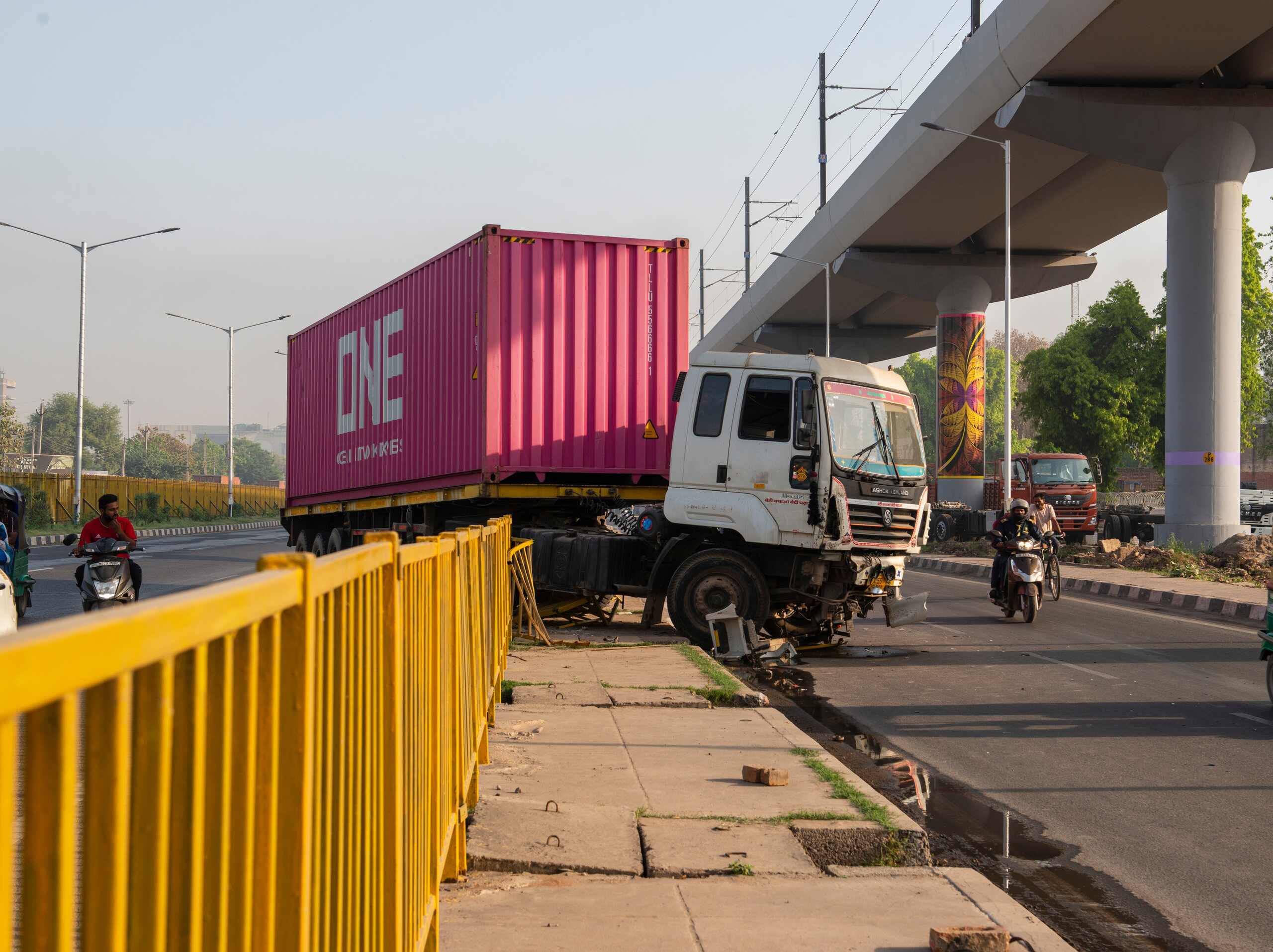
These answers cover questions about records, insurance, and deadlines after an I-40 truck accident in Oklahoma City.
Federal law bars an NTSB Board accident report from being admitted into evidence or used in an Oklahoma truck accident lawsuit for damages resulting from a matter the report mentions. NTSB rules say no statute bars admission of the separate factual accident report written by NTSB investigators.
Discover the key timeline factors and what you can expect during a truck accident lawsuit in Oklahoma.
A trucking company’s accident register, which motor carriers must keep for three years after each accident, lists the date, the city or town and state, the driver’s name, the number of injuries and fatalities, and any hazardous materials release. It also holds copies of accident reports required by states or insurers.
The MCS-90 endorsement does not cover injury to or death of the trucking company’s own employees while they are on the job. It also excludes the cargo the carrier is hauling.
An Oklahoma collision report costs $7.00 when requested on Service Oklahoma’s form. A certified copy adds $3.00 per record.
Highway Patrol dash camera footage and 911 audio can be requested after an I-40 crash through the Department of Public Safety’s Dash Cam Video Production Unit. Requests are worked in the order received, can take up to 90 days or more, and are delivered by digital download at no cost.
Troop S of the Oklahoma Highway Patrol enforces commercial motor vehicle laws and Federal Motor Carrier regulations. The Highway Patrol lists it as Commercial Motor Vehicle Enforcement, and it is known as Size and Weights.
After an I-40 truck accident in Oklahoma City, Graves McLain Injury Lawyers reviews the collision report, the carrier records, and each policy that may apply. We represent people across Oklahoma, including Oklahoma City, from our Tulsa office.
You pay nothing unless we recover for you. If you are looking for an Oklahoma City truck accident lawyer, call Graves McLain Injury Lawyers at (918) 359-6600 for a free consultation.