A normal CT or MRI result does not by itself end a mild traumatic brain injury claim in Oklahoma. The claim turns on evidence the law allows a jury to hear: records, lay witnesses, and opinion testimony from qualified witnesses.
At Graves McLain Injury Lawyers, we take serious cases for seriously injured people across Oklahoma from our Tulsa office. We gather the records, identify the witnesses, and prepare opinion testimony with Oklahoma’s admissibility rule in mind.
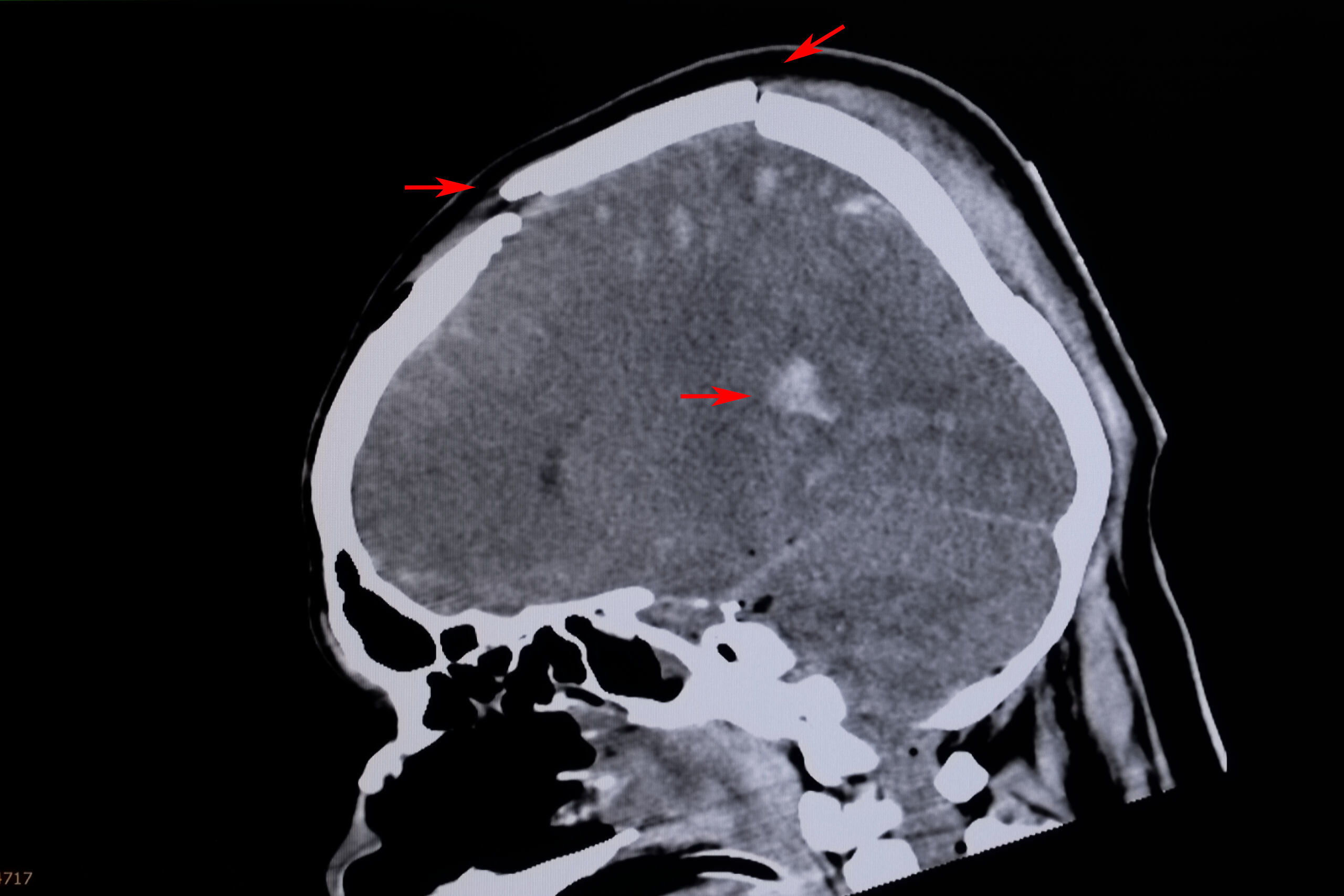
A mild traumatic brain injury claim in Oklahoma can move forward after a normal CT or MRI, because the law measures the claim by all admissible evidence, not by one test result. A normal CT scan does not end a brain injury claim on its own; it is one piece of the record.
When a rear-end crash on I-44 or a fall in a Tulsa store is followed by a normal scan, proving mild TBI without imaging means we look to the records made at the time, the people who noticed a change, and the qualified witnesses who can speak to it.
The records in a mild TBI claim are the documents created at the time of the injury and afterward, and Oklahoma’s hearsay rules decide which of them a jury may see. Hearsay is an out-of-court statement offered to prove that what it says is true.
Oklahoma’s business-records hearsay exception keeps a record of acts, events, conditions, opinions, or diagnoses from being excluded as hearsay when it meets conditions under Okla. Stat. tit. 12, § 2803(6). The record must be made at or near the time by a person with knowledge, or from information that person gave. It must be kept in a regularly conducted business activity that makes such records as a regular practice.
The law counts an institution or a profession as a business, so hospital and clinic records can qualify. The exception does not apply if the source of the information, or the way or circumstances in which the record was prepared, indicate a lack of trustworthiness.
The records we request include:
We request each set from its source and track when each was made.
Employment and school records can show the effects of a traumatic brain injury on work and daily routine in documents written by people who are not parties to the claim.
When follow-up evaluations happen weeks after a crash, the record builds slowly, and that timing affects how long a TBI claim takes.
Oklahoma courts decide whether opinion testimony from a qualified witness, including opinions based on neuropsychological testing, is admissible under the state’s rule for scientific and technical evidence, Okla. Stat. tit. 12, § 2702, and the Daubert standard.
Under that rule, a qualified witness may give an opinion only if the side offering it shows the court it is “more likely than not” that four things are true:
An opinion that falls short on any of the four does not meet the rule.
The Oklahoma Supreme Court, in the Christian v. Gray decision, adopted the Daubert and Kumho standards for Oklahoma trial courts in civil cases. Under that approach, the trial judge acts as a gatekeeper, screening the opinion for relevance and reliability before the jury hears it.
Tulsa County District Court applies the state rule, while a case in the U.S. District Court for the Northern District of Oklahoma follows Federal Rule of Evidence 702, which uses the same more-likely-than-not showing. In most federal proceedings, whether evidence comes in is decided under the Federal Rules of Evidence.
When neuropsychological test results support an opinion, the witness offering it must meet the same four requirements. We identify which treating providers and retained witnesses can meet those requirements, and people across Oklahoma can review that plan with a Tulsa brain injury attorney at our firm.
In an Oklahoma concussion claim, people who know the injured person, such as family members, coworkers, and friends, can testify to changes they personally observed, within the limits of the state’s lay-opinion rule, Okla. Stat. tit. 12, § 2701.
That rule sets three limits. A lay witness’s opinion must be rationally based on what the witness perceived and helpful in understanding the testimony or deciding a fact in the case. It also cannot rest on the scientific, technical, or other knowledge covered by the state’s rule for scientific and technical evidence.
A spouse can describe what they saw at home, but cannot give a diagnosis. Lay witnesses in a concussion claim in Oklahoma can include:
These witnesses carry the before-and-after comparison of work, household, and social routines. We pair each account with records from the same period, so a coworker in Owasso or Jenks speaks to the months the employer’s attendance records cover.
An independent medical exam in an Oklahoma injury case is a physical or mental examination the opposing party may request when the injured person’s condition is in controversy and that person relies on it in the claim, under Okla. Stat. tit. 12, § 3235. The statute does not use the phrase “independent medical exam.”
Oklahoma’s physical and mental examination statute requires the request to spell out the time, place, manner, conditions, and scope of the exam, and who will conduct it. The statute also sets these rules:
When a request comes in, we review its scope against the statute and attend the exam or arrange representation. Before asking for the examiner’s report, we talk with the client about how that request affects privilege.
A mild traumatic brain injury claim in Oklahoma is shaped by a two-year filing deadline, a shared-fault rule, and a noneconomic damages limit with several exceptions. Under Oklahoma’s statute of limitations, Okla. Stat. tit. 12, § 95, a personal injury lawsuit that does not arise from a contract generally must be filed within two years.
Under Oklahoma’s comparative negligence statute, Okla. Stat. tit. 23, § 13, an injured person’s own negligence bars recovery only if it is greater than the negligence of the person who caused the harm, or greater than the combined negligence of those who caused it. A person found 50 percent or less at fault may still recover, though a companion section reduces the award by that person’s share of fault.
A separate Oklahoma statute, Okla. Stat. tit. 23, § 61.3, generally limits noneconomic damages in a bodily injury case to $500,000, while economic loss has no limit. The limit applies to injuries that occurred on or after the law’s effective date.
The limit rises to $1,000,000 if the judge or jury finds “a permanent mental injury that itself severely impairs the plaintiff’s ability to be employed or enjoy a reasonable standard of living.”
There is no limit for a permanent and severe physical injury. There is also no limit when the judge and jury find, by clear and convincing evidence, that the defendant acted in reckless disregard of the rights of others, with gross negligence, fraudulently, or intentionally or with malice.
Proof of permanence depends on admissible evidence, including opinion testimony from qualified witnesses under the same four-part rule.
These answers address procedural questions in a mild traumatic brain injury claim in Oklahoma.
In an Oklahoma injury lawsuit, the other side cannot serve a request for an examination until 30 days after the summons and petition are served on the defendant. The request must set the exam at least five days after the notice is served. If the person objects, the court may set conditions for the exam or refuse it when the condition is not in controversy.
A treating doctor can give opinion testimony in an Oklahoma brain injury claim on the same terms as any witness offering an opinion based on scientific or technical knowledge. The four requirements apply the same way to a retained witness.
A mild TBI claim in Oklahoma does not have to go to trial, because it can resolve by agreement at any stage. If it does not, the same evidence rules govern what the jury hears.
Medical and employment records in an Oklahoma injury case are not excluded by the hearsay rule when they meet the business-records exception. The side offering the records shows the exception applies through testimony from the records custodian or another qualified witness, or through a certification that meets the statute’s requirements.
In an Oklahoma brain injury claim, statements made to a doctor can fall under a separate hearsay exception for statements made for purposes of medical diagnosis or treatment, Okla. Stat. tit. 12, § 2803(4). That exception has conditions, including that the statement be reasonably pertinent to diagnosis or treatment. Meeting them keeps the statement from being excluded as hearsay, but it is not automatically admitted.
If your mild traumatic brain injury claim is disputed after a normal scan, Graves McLain Injury Lawyers can review the proof with you. Call (918) 359-6600 to talk with a Tulsa brain injury attorney at our firm about the records, witnesses, and testing in your claim.
The consultation is free. You pay nothing unless we recover for you.
We represent people across Oklahoma, including Broken Arrow, Owasso, and Jenks.